Does a graph of models beat one good model?
A hypothesis-led study of per-query model graphs, tools, local models and memory
Research studyNovember 202648 min read
Abstract
A recurring idea in AI systems is the dynamic topology. The structure that processes a problem is assembled for each problem and is not fixed in advance, so an easy question takes a light path and a hard one takes a dense path. I built a version of it at the level of whole models and tested it. A fast decision model acts as controller, small and large language models are the workers, some of the workers run on my own machine, and all of them can use a sandboxed code tool.
The question was whether a graph assembled per query beats the best single model on accuracy, cost and latency. I set down eight hypotheses, before looking at results, and added twelve more as the results raised new questions. Five of those twelve had their test and their success criterion written down before the run, and the other seven were written up alongside their first results. I scored all twenty. That makes this an exploratory round. I have since written a pre-registration for a second one, which fixes every endpoint and test before any data and uses fresh questions where the sets allow, and I will report it separately in an addendum to this article.
Based on this preliminary study, the short answer is that no, it does not, yet.
Routing between a cheap and an expensive model came closest. It was nominally ahead of the best single model on three datasets, at roughly half the cost, and was not significant on any of them. A cheap model with a code tool turned out to be a far stronger baseline than a large model without one, and that changed the comparison more than any clever composition did.
The same held for problems that only sound hard. With Python, the cheap model solved all 29 competition-style counting problems I gave it for a fiftieth of the strong model's price, and 46 of 48 problems built around textbook algorithms.
Splitting a problem into parts helped when the parts were independent and hurt when they formed a chain. On the hardest set, a verified fan-out of cheap models matched the best model's price but lost thirteen points of accuracy. The one idea that clearly worked was verification, a harness-run check that makes a cheap model's guesses trustworthy.
I also wanted more than savings, which meant a system that gets better from its own experience, so the last part of the study is about memory. Recalling a past problem by the kind of problem it is worked better than recalling it by its wording. A verified answer could be reused safely once a typed check separated a paraphrase from a lookalike. A stored program let a cheap model solve three of four puzzles it had failed, although a larger, matched test found no gain in accuracy.
Memory did not route better than a plain difficulty score, between a fifth and a third of the programs I stored as verified were wrong, and I found few real analogues between different problems in the test suite.
A memory that learned as it was used got steadily cheaper at no cost in accuracy, but wrong answers stored as verified cost 28 points of accuracy until a re-check of reused answers retired them. On ARC puzzles that come with a second test input, a stored rule made the repeat 81% cheaper and 74% faster and did not make it more accurate.
1. Introduction
The question is easy to state.
Does a graph assembled per query, with a fast decision model as controller, small and large models as workers, local models, and tools, beat the best single model on the accuracy, cost and latency frontier?
"Best single model" needs care, because that is where studies like this quickly go wrong. I define it as the better of that model with and without its tools. I did not do that at first. My early comparisons were against models with no sandbox, and the headline result weakened once the baseline was allowed to use one. That correction changed how I ran everything after it, and it is why the hypotheses below are scored against tool-equipped baselines wherever they exist.
The first eight hypotheses, H1 to H8, are the ones set down at the outset. Of the twelve added later, H12, H13, H15, H16 and H17 had their test and criterion written before the run. H9, H10, H11, H14, H18, H19 and H20 were written up with their first results, so they carry less weight. Where the second round disagrees with anything below, the second round is the one to believe.
| Hypothesis | |
|---|---|
| H1 | Routing. A controller can send easy questions to a cheap model and hard ones to a strong model, matching the best single model's accuracy at lower cost. |
| H2 | Tools. Compute is the lever on mechanical work, and model size matters less. |
| H3 | Composition. On hard reasoning, fan-out, verification and escalation lift cheap models to the best model's accuracy for less money. |
| H4 | Calibration. The controller's probabilities are reliable enough to gate escalation. |
| H5 | Memory. Recalling similar past problems improves routing. |
| H6 | A free first stage. Local models plus a verifier shift work off the API bill. |
| H7 | Controller independence. A local decision model triages about as well as the hosted one. |
| H8 | Tool ability is a property of the node. Whether a worker can call tools changes what it can solve, independent of its size. |
The later ones, in the order they were added, were these.
| Hypothesis | |
|---|---|
| H9 | Tool routing. Switching tools on only where they help beats always-on tools. |
| H10 | Tools make hard problems cheap. When a program does the computation, a hard-sounding problem does not need a strong model. |
| H11 | Fan-out. Splitting a multi-part message and working the parts in parallel beats one worker doing it all in sequence. |
| H12 | Memory keyed by kind. Recalling past problems by what they are routes better than recalling them by their wording. |
| H13 | Graph memory routes. What two strategies did on similar past problems routes better than difficulty alone, at equal spend. |
| H14 | Claim reuse. A verified sub-answer can replace a worker without ever returning a wrong answer for a near-identical question. |
| H15 | Program reuse. A stored, verified program, gated by running it on the new puzzle's own examples, solves repeats with no model call and no wrong accept. |
| H16 | Method analogy. A stored solution that shares a method lifts a cheap model on problems it otherwise fails. |
| H17 | Hints from a similar solved puzzle. The nearest solved puzzle's program lets a cheap model solve puzzles it failed. |
| H18 | Online learning, and a wrong memory. As memory grows with use, reuse rises and cost falls without losing accuracy. A wrong "verified" answer does damage unless something re-checks it, and a cheap re-check repairs it. |
| H19 | Accuracy with memory on ARC repeats. On puzzles the cheap system fails, giving it a stored rule from the same puzzle's first task raises its accuracy. |
| H20 | Agreement as a second opinion. When a worker with a stored rule and an independent worker give the same answer, that answer is right more often than one worker's answer. |
2. Dynamic topologies, and the research around them
A dynamic topology is any system whose structure depends on the input: which parts run, how they connect, how much of it is used. The claim is easy to overstate, because "the structure adapts" can mean very different things. Sorting the work into levels shows what a system actually varies and what evidence it needs.
Inside one network
The oldest version is a single network using different amounts of computation for different inputs: early exit (stop at an intermediate layer once confident), mixture of experts (route each token to a few specialist sub-networks) and token skimming (let easy parts of the input skip layers). [1, 2, 3] This is topology varying per input in the literal sense, inside the model.
Between models
The next level treats whole models as components. A router picks a strong or weak model per query, or a cascade tries cheap models first and escalates when an answer looks unreliable. FrugalGPT reported that a cascade across commercial APIs could match a strong model's quality at a fraction of the cost, and RouteLLM trained routers on preference data to cut costs by more than half in some cases without losing quality. [4, 5] Conformal Cascade, a recent preprint, accepts an answer at a tier only when a calibrated prediction set collapses to one answer, which guarantees that the accepting tier's set contains the right answer where an uncalibrated threshold guarantees nothing. [6] Routing's inherent limit is that it must choose before it sees the answer, so everything rests on how well it estimates difficulty.
Between agents
The third level builds a workflow per query. GPTSwarm, the one framework the Agent Patterns Catalog lists under dynamic topology routing, treats a team of agents as a graph and learns a distribution over its edges. [14, 15] G-Designer generates a communication topology with a graph neural network. MaAS trains an "agentic supernet" and samples a subnetwork per query. FlowReasoner trains a small reasoning model to write a new multi-agent system per query. AgentConductor has an orchestrator infer difficulty and build a layered graph whose density grows with it, refining it from execution feedback. GraphPlanner treats workflow generation as a decision process over model and role at each step, with a graph memory of past queries. [7, 8, 9, 10, 11]
Reading these papers for what they compare against, I found four things. None compares a structure with a stronger single model given the same tools; baselines are prompting methods and other multi-agent systems, mostly on the same backbone. The nearest are FlowReasoner, which beats its worker model o1-mini by about ten points overall on three code benchmarks without saying whether that model could run code, and the GAIA tables in GPTSwarm and MaAS, which include GPT-4 alone (GPTSwarm's also has GPT-4 with plugins, at 14.6 against its own 18.5). Where benchmarks near their ceiling the margins are small: G-Designer leads the best baseline by 0.2 to 1.3 points on five of six sets and trails a single-agent method on the sixth, and MaAS leads by 1.3 points on average. The strongest results, FlowReasoner's and AgentConductor's, come with generated code run against tests, so the topology's share of the gain is unclear. And the reporting is loose: none reports significance tests, and in at least three of the seven papers (G-Designer, MaAS, AgentConductor) a headline figure does not follow from the paper's own tables. AgentConductor's abstract claims a lead of up to 14.6 points over the strongest baseline; the largest lead in its results table is 7.5. These figures are the authors' own and I did not reproduce them.
Within a run
The finest-grained version changes structure during a problem. DyTopo rebuilds the communication graph among a small team every round (a manager and three or four workers). The manager sets the round's goal and decides when to stop, each agent writes what it needs and what it can offer, the descriptions are embedded, and a message passes only when an offer matches a need above a similarity threshold, with at most three providers per agent. [13] On HumanEval, APPS, MATH-500 and Omni-MATH, across four backbones sized 8B to 120B, it beats every baseline in all sixteen settings, by 0.9 to 17 points.
It is the published system closest to this study's grow-as-you-go strategy, although mine adds nodes and switches models where DyTopo rewires a fixed team. It also runs the comparison that matters, a random topology at the same sparsity, which scores below DyTopo in all sixteen settings: real evidence that the structure does work. It reports tokens and latency on one benchmark and backbone only. On HumanEval it costs about 15 times a single pass's tokens and latency for 5.5 more points, and about half the tokens of a fixed multi-agent pipeline. Its baselines share its backbone, so none is a stronger single model, and the paper does not say whether any method executes code. There are no significance tests, and two sets are small (100 and 70 problems). I read DyTopo as good evidence that dynamic routing beats static routing among equal agents, and silent on whether it beats one stronger model with its tools.
| System | What varies | How it is decided |
|---|---|---|
| Early exit, mixture of experts | Layers or experts used | Learned gates inside the model |
| FrugalGPT, RouteLLM | Which model answers | Cascade, or a router trained on preferences |
| Conformal Cascade | Where the cascade stops | Calibrated prediction-set size |
| GPTSwarm | Prompts and edges of an agent graph | A learned distribution over edges, optimised with REINFORCE |
| G-Designer, MaAS | Agent communication graph | Graph model or sampled supernet, trained |
| FlowReasoner, AgentConductor | The workflow, written per query | A trained meta-agent or orchestrator |
| GraphPlanner | Model and role at each step | A graph network over past queries, trained with reinforcement learning |
| DyTopo | Who talks to whom, every round | Semantic matching of each agent's stated need and offer |
Where this study sits
This study works at the model level, with some of the agent level's growth and memory. Its controller is a fixed decision model not trained for this work, so there is no learned topology generator and no reinforcement learning. Its grow-as-you-go strategy resembles AgentConductor's difficulty-aware density, adding nodes while confidence stays low. Its memory began as a plain nearest-neighbour store, a much simpler version of GraphPlanner's graph memory, and hit a limit the graph version is designed to overcome (section 8). I then built a small graph store to test what a graph adds (section 9), with no learned policy on top.
It differs from the papers above in three ways. It compares against a single model given its tools, which none of them does in its headline result (FlowReasoner comes nearest, against its worker model alone). It asks separately what the verified part of a composition is worth, which the best published results fold into the topology. And it trains nothing, where every method above except DyTopo learns its router or generator on tens to thousands of examples from the evaluation's own distribution, which raises benchmark accuracy and risks overfitting.
3. The system
The controller is a decision model that answers typed questions (yes or no, a choice, a score) with a probability for each answer. It takes tens of milliseconds and a fraction of a cent, and it routes, judges whether an answer is settled, and picks the next step. Workers are three Claude models (Haiku, Sonnet, Opus) through a model gateway plus two local Qwen3.6 models, and each can run Python in a sandbox with the network off.
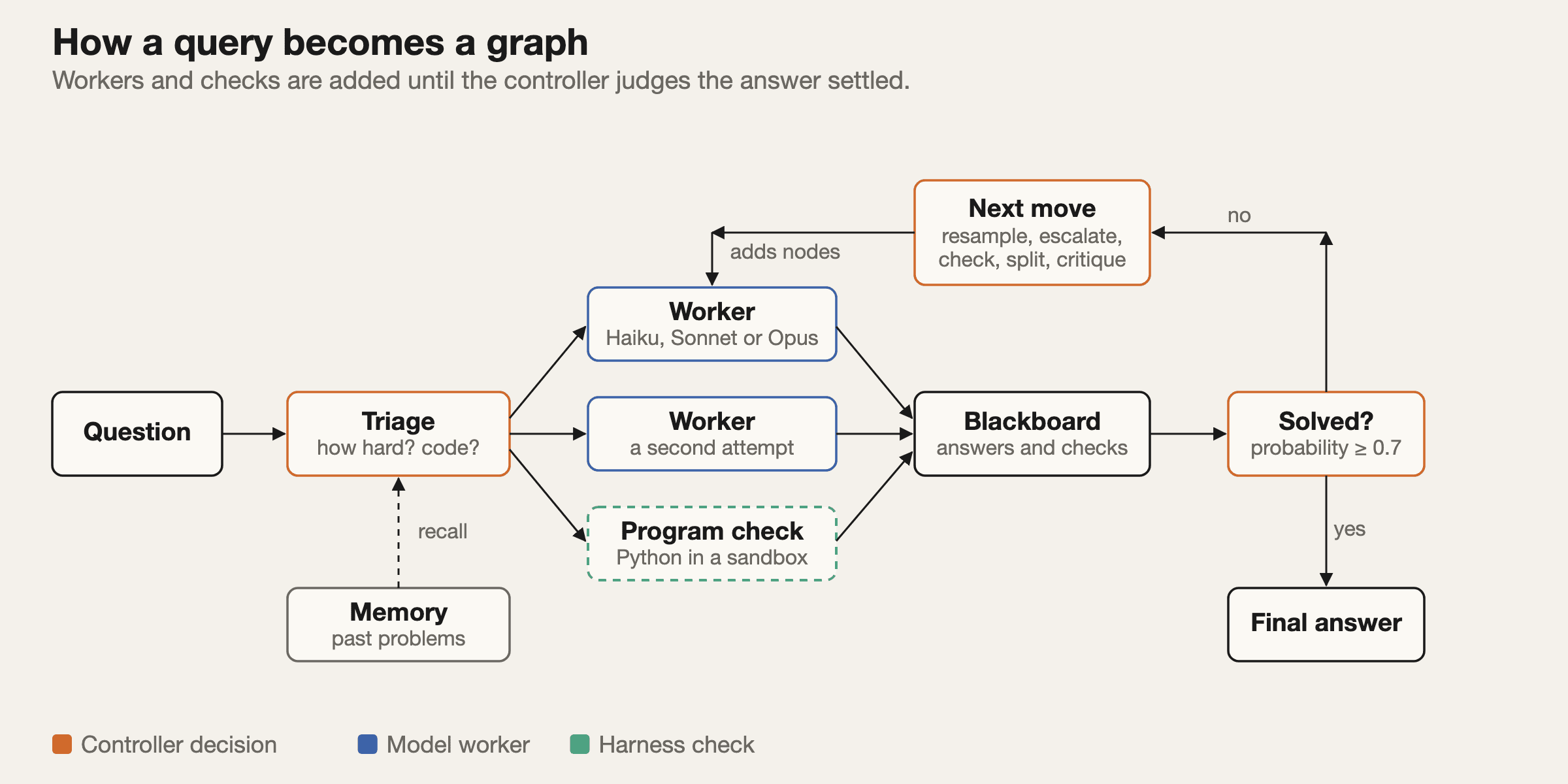
A query becomes a graph as it runs: an easy one ends after three nodes, a hard one grows until the controller judges the answer settled. Two memories feed it, a per-run blackboard of candidate answers, program checks and critiques that the controller reads in compact form, and a persistent store of past problems with the cheapest tier that solved each.
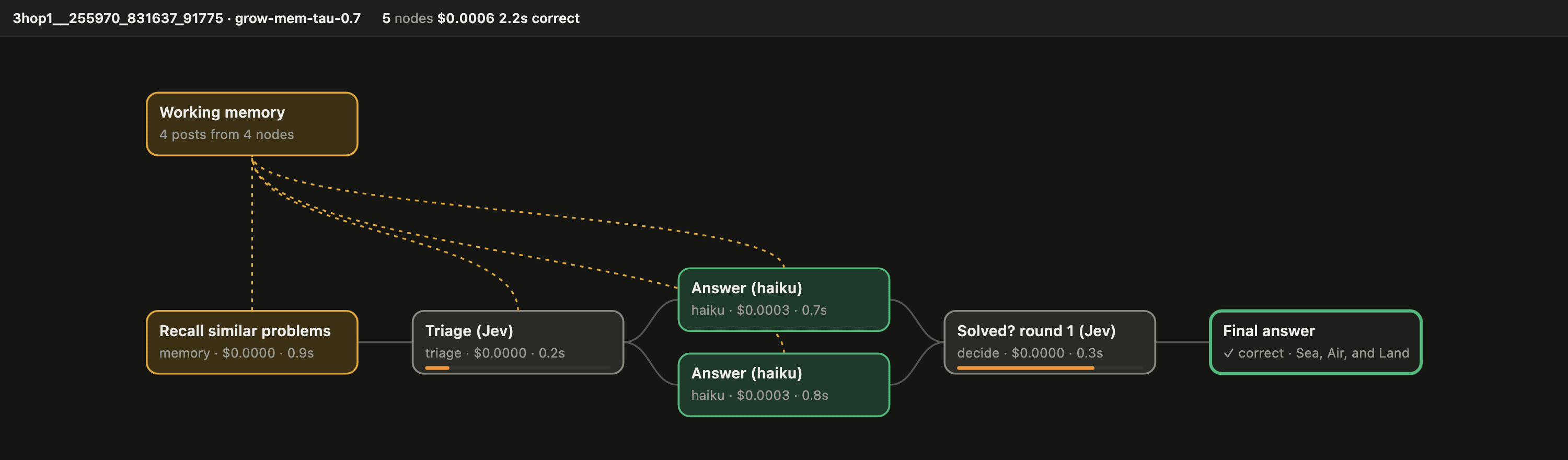

I compared strategies on the same questions, scored by exact match, with paired tests (exact McNemar and Wilson intervals) throughout. The datasets were AIME, MuSiQue, GPQA-Diamond, three families of generated tasks with exact gold answers, and ARC-AGI-2. Every run writes a trace, and a viewer replays one as a graph growing on a clock.
The system also runs behind a chat interface. The controller triages each message and starts only the workers it needs, which can include a sandbox, web search, uploaded files and a split into parts; a writer then streams one reply with the routing shown. Long runs checkpoint and resume. The memory work uses a small in-process Postgres graph store with nodes for problems, sub-questions, claims, programs, strategies and models.
4. Routing came close (H1)
On AIME and MuSiQue with no tools, the best router was 29% cheaper than Opus for 1.1 points less accuracy, well inside the noise. GPQA-Diamond was the interesting case: Haiku and Opus are nearly tied (88.0% and 89.3%) but miss different questions. A perfect choice between them would reach 94.7% at about $0.003 a question, and a threshold rule on the controller's difficulty score got within 1.4 points of that, at 93.3% for 47% of Opus's cost.
That looked like a result until I gave Opus its sandbox. Opus with tools scored 90.0% on GPQA, and the router's lead shrank to nine questions won against four lost (p = 0.27). On the 40 MuSiQue questions both sides answered, Opus with tools scored 87.5% and the router 95.0% (three won, none lost, p = 0.25), and a grown graph with memory 92.5% at 59% of the cost.
The router was nominally ahead on all three datasets and significantly ahead on none. The pattern is more persuasive than any single result but not established at these sample sizes. I score H1 as mixed, leaning towards supported.
5. Tools matter most on mechanical work (H2, H8)
I built families of generated tasks with exactly computed answers, so no model could have memorised them: sums over spreadsheets, joins across CSVs and PDFs, ledger reconciliation, fuzzy name matching. Haiku with Python scored 98.8% on the first family at $0.0013 a question, and Opus without tools 67.4% at $0.12. The tool was worth 38 points to Haiku and 33 to Opus, and halved Opus's cost, since it no longer worked through the spreadsheets cell by cell.
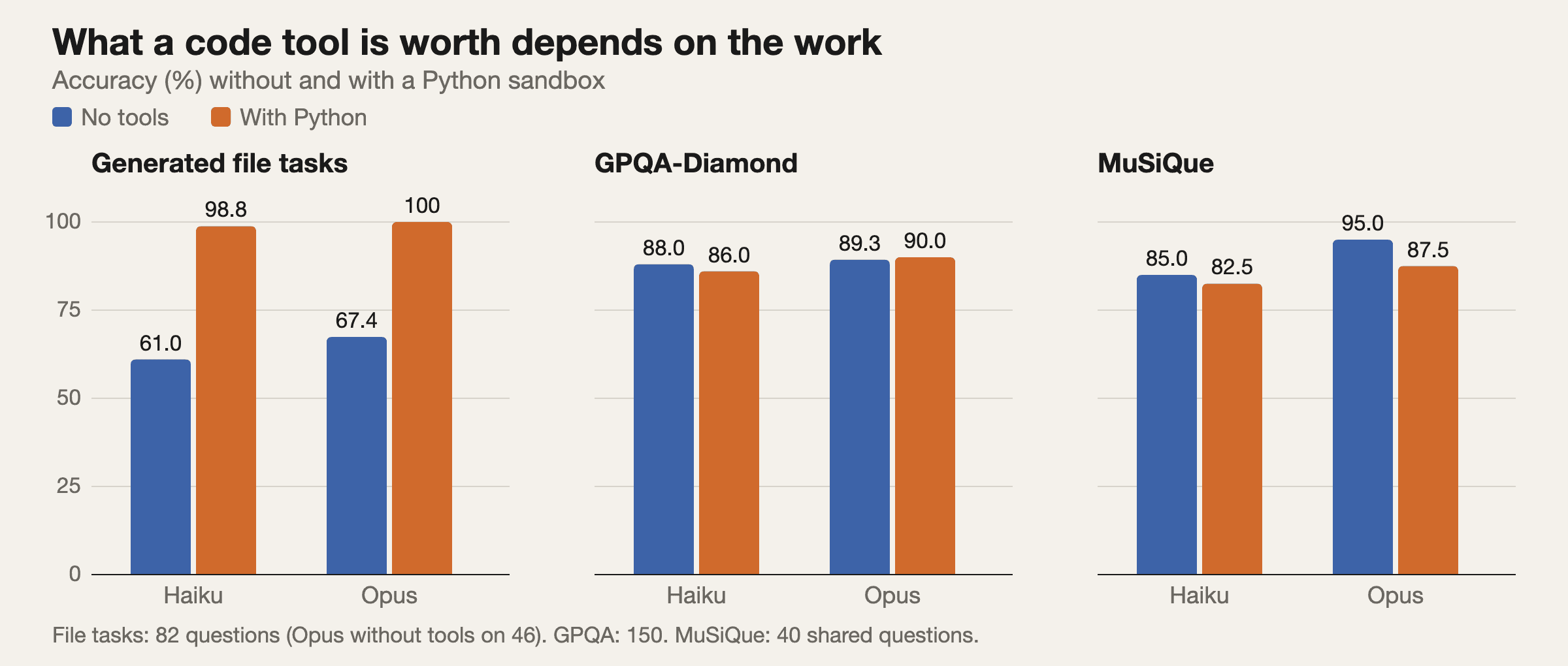
How much a tool helps depends on the work. On GPQA, which calls for recall and reasoning, tools did nothing, and Haiku opened the sandbox on 10 of 150 questions. On MuSiQue and AIME they were slightly negative: Opus with tools lost 7.5 points on MuSiQue (three questions lost, none gained), though at that size I would not call the loss real. A model that reaches for code may reason less in prose; I did not test that.
The generated families also saturated, which I should have seen sooner. Every agent scored 100% on the harder file tasks and the reasoning-plus-tools tasks, so no composition could show anything. A set a cheap model with a tool already solves cannot test whether a network helps.
Problems that sound hard (H10, H16)
The controller rates difficulty from the wording, and competition mathematics sounds hard. I built forty problems that read like olympiad combinatorics and number theory but that a short program settles exactly (restricted subsets with a modular sum, permutations with adjacency conditions, strings avoiding substrings, knight walks), each answer recomputed by a different algorithm. Haiku with Python solved all 29 test problems at $0.0003 each; Opus with Python solved all 29 at $0.0158, about fifty times the price. A router that sends hard questions to Opus rated all 29 hard and paid for Opus every time, for the same result.
I then tried problems where the method is hard and the arithmetic easy: Burnside's lemma for bracelets, digit dynamic programming up to 10^17, the Lucy sieve for the sum of primes below several billion, partition numbers by the pentagonal recurrence, matrix exponentiation at lengths near 10^15, each in two stories, with every answer checked against an independent implementation and each method against brute force on small cases. Haiku with Python solved 46 of the 48 test problems at about a tenth of a cent each; it recalls these techniques unprompted. I had meant to test whether a stored solution to a similar problem would help, and stopped at the first gate because there was nothing to improve. Opus beats Haiku where the difficulty lies in seeing the structure, as in ARC, GPQA and multi-hop reading, and does not where the method has a name.
Routing the tool (H9)
If tools help on mechanical work and hurt slightly elsewhere, the controller should switch the sandbox on only where it helps. I replayed this for free, since each question had already been run with and without the sandbox for Haiku and Opus, choosing thresholds by cross-validation on 272 questions. Gating on the controller's probability that code would help added one to two points over always-on tools at every threshold from 0.4 to 0.6 and for every model policy (Haiku 88.6% to 90.4%, Opus 92.6% to 93.8%). None was significant; the largest was six questions won and one lost (p = 0.13). A combined router scored 91.2% at $0.0066 a question against 92.6% at $0.0264 for Opus with tools (p = 0.48): the same accuracy within the noise for a quarter of the price, with most of the saving from choosing Haiku over Opus and little from choosing tools.
The result depends on the controller. With the small local decision model in place of the hosted one, the same router scored 86.8%, significantly worse than Opus with tools (5 questions won, 21 lost, p = 0.002), because its scores sent almost everything to Haiku. That model had ranked Haiku's mistakes well on one dataset (section 8), so a score that ranks difficulty well can still route badly.
6. Splitting a message (H11)
A message with several separate asks can be split and the parts worked at once. I bundled three or four computable problems into one message and asked for the integers in order. A cheap model cut the message into parts, independent parts ran side by side as Haiku agents with Python, and the answers were joined. All 17 test tasks came out right (60 of 60 parts), matching one Opus agent given the whole message, at $0.0015 a task against $0.0290 and faster on average (14.8 s against 22.0 s). One Haiku agent given the whole message got 15 of 17, its misses the cost of cramming four problems into one context and time budget; the fan-out won two tasks and lost none (p = 0.5), which is suggestive only.
The fan-out does not always help. When parts formed a chain, each using the earlier answers, a single Haiku agent was best, with every part right in 8.0 s for $0.0004 against 19.1 s and $0.0019 for the fan-out, which paid for a sandbox run per part and waited for each predecessor. A chain of computations is one program for one agent, so the chat now declines to split one. When one part was a hard ARC puzzle among easy parts, the fan-out gave no speed-up, since the hard part is the critical path. A cascade of two Haiku agents per part with Opus on disagreement got 6 of 10 grids right at $0.138 a task, against 8 of 10 for one Opus agent at $0.199, on puzzles chosen because Opus had solved them before, so ten tasks cannot rank the two. Splitting earns its cost when parts are independent or need different tools.
7. The hardest set (H3)
ARC-AGI-2 was the one set where cheap agents were not at 100%. A worker sees worked examples as a file, can run Python, and answers with a grid. On twenty tasks Haiku alone solved four, eight Haiku agents voting solved nine, and four Haiku agents with escalation to Opus solved thirteen against Opus's fourteen. That first slice looked as if the network could tie the best model for less.
I then built a verifier, which is the part that worked. The harness, not the model, runs each proposed rule over every worked example and accepts only one that reproduces them all. On the same twenty tasks the verified Haiku network scored 15 against Opus's 14, but over sixty tasks the result did not hold.
| Opus with Python | Verified Haiku network | |
|---|---|---|
| Correct | 49 of 60 (81.7%) | 41 of 60 (68.3%) |
| Cost per question | $0.221 | $0.221 |
| Median latency | 47 s | 226 s |
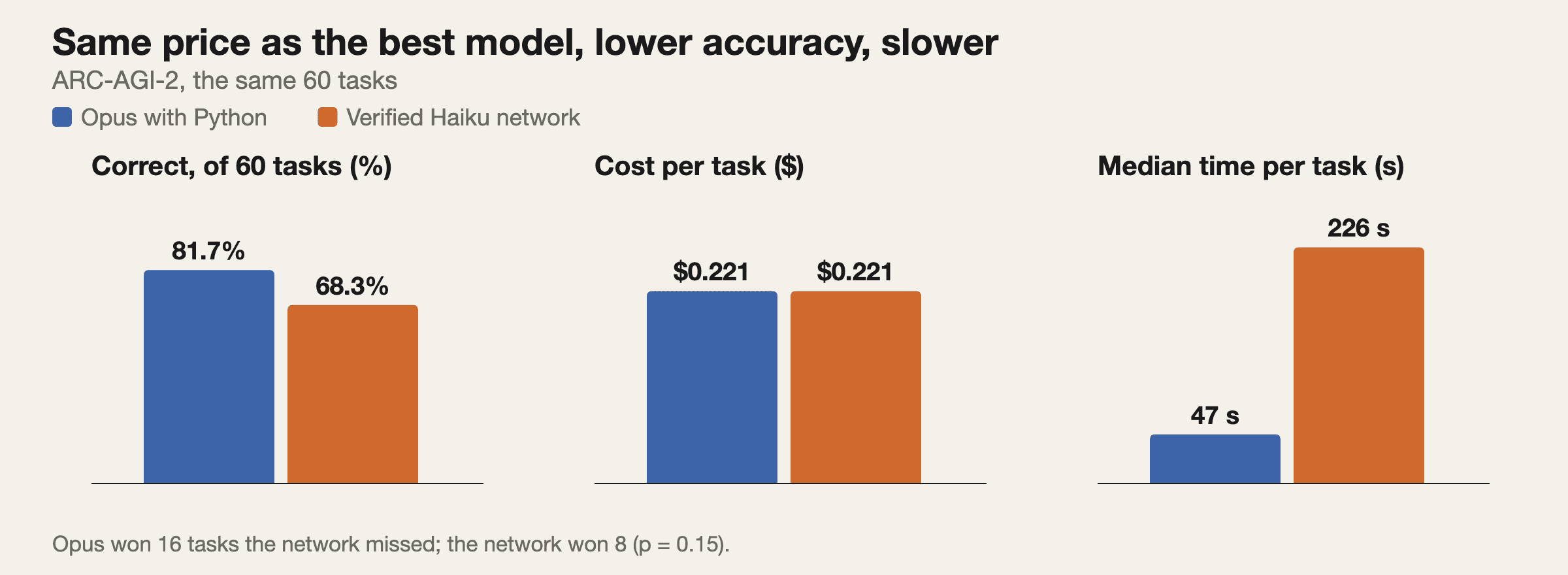
Opus was right on 16 tasks the network missed and the network on eight that Opus missed (p = 0.15). The cost tie follows from escalation: every task the cheap attempts could not verify went to Opus, so the network paid for the failed attempts and Opus's price on top. The verifier let a cheap model's guesses be trusted but could not make the hard cases cheap, since they still ended at Opus. H3 is not supported on this set.
8. Calibration, memory and the controller (H4, H5, H7)
Calibration (H4)
The controller's probability that an answer is settled was well calibrated on GPQA: the leading answer was right 43% of the time below 0.5 and 95% above 0.8. On AIME and MuSiQue together it was not: at 0.7 and above the leading answer was right 88% of the time, barely above Haiku's 85% base rate on those sets (on MuSiQue alone, 82% against 78%). The controller detects disagreement between attempts, not error, so a confidently wrong answer looks like a confidently right one.
Memory (H5)
Nearest-neighbour recall on question text found a close enough neighbour for 4 questions of 96. The similarities (0.38 to 0.52) did not group problems by difficulty, because problems with the same structure share no wording. As a router it failed. Given to the controller as one line of context ("84 similar problems, Haiku solved most"), the same memory lifted a grown graph from 91.7% to 93.8% on the 96 AIME and MuSiQue questions (three won, one lost). All of the change was on MuSiQue, from 86.7% to 90.0% on its 60 questions with cost about halved; AIME stayed at 36 of 36 at slightly higher cost. That is suggestive, not established. Keying memory on a short description of the task rather than its text is tested in section 9.
The controller (H7)
The controller is a hosted model I cannot run myself, so I asked whether anything free and local could do its job. I put the same triage questions to a small open decision model (0.85 GB) on 246 stored questions and measured, for each controller, how well its difficulty score ranked the questions Haiku got wrong (AUC 0.5 is chance).
| Dataset | Haiku's errors | Hosted | Local |
|---|---|---|---|
| GPQA-Diamond | 18 of 150 | 0.72 | 0.67 |
| MuSiQue | 13 of 60 | 0.48 | 0.70 |
On GPQA they are close. On MuSiQue the hosted score ranked Haiku's mistakes no better than chance and the local one's ranked them well. The two controllers barely agreed (correlations 0.04 to 0.41). With 13 errors an AUC carries about ±0.15, and some hosted scores came from runs given recalled neighbours, so I read this as showing a free local controller is not obviously worse, not that it is better.
A local model as the stopping gate
The controller's most frequent question is whether a growing graph can stop ("is this solved?"). I tried a second local model on that question alone: DiffusionGemma, a 26B open model that generates text by diffusion. Used as a classifier it gets the question and an answer with the yes-or-no slot blank, and one forward pass, about a second on the laptop, gives the probability of each label.
I replayed the 711 stored stopping decisions with a known outcome (from 246 questions, each run under up to four configurations), so both controllers judged the same boards. The local model ranked right leading answers above wrong ones better, with an AUC of 0.81 against 0.73 (p = 0.013, resampling whole questions): 0.80 against 0.70 on MuSiQue, and 0.75 against 0.70 on GPQA, which is not significant alone (p = 0.4). Stopping at 0.7 it stopped on 590 boards and was right on 92% of them; the hosted controller stopped on 568 and was right on 90%.
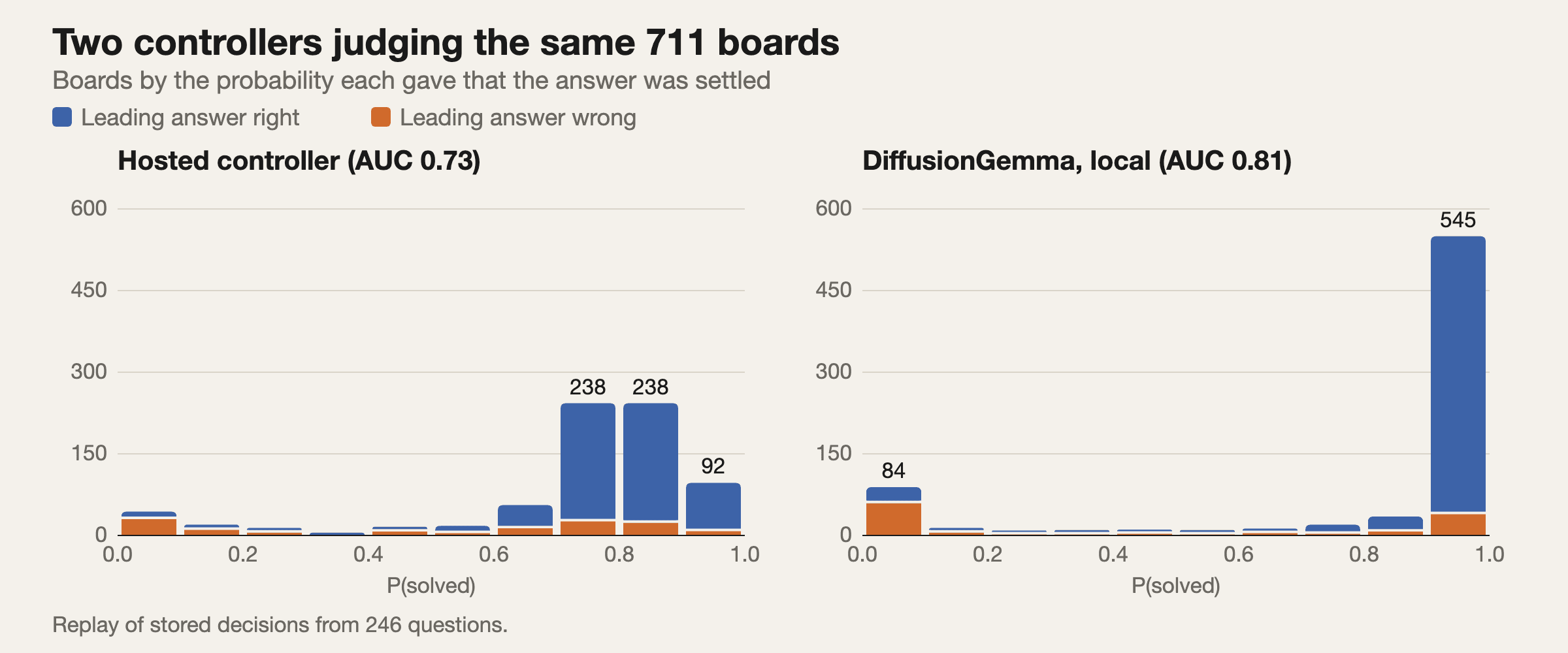
A replay has a weakness: every board was grown under the hosted controller's stopping rule, and a different gate would grow different boards. So I ran a small live pilot ($0.87, 20 questions) with the local model deciding and the hosted one answering the same gate unseen. On its 18 MuSiQue gates, ten with a wrong leading answer, the result reversed: the hosted AUC was 0.91 and the local 0.73. Four wrong leaders got 0.96 to 1.0 from the local model and 0.62 to 0.81 from the hosted one. Most local answers fall below 0.05 or above 0.95 (25 of the pilot's 28, 606 of the replay's 711), which makes it closer to a switch than a probability.
Eighteen gates decide nothing; I report the pilot because it points the other way. At triage the same model was no improvement: its difficulty score ranked Haiku's errors slightly worse than the hosted controller's on GPQA (0.67 against 0.71) and better on MuSiQue (0.60 against 0.48), the same mixed picture as the smaller local model, and its route choice carried almost no information, sending 239 of 246 questions to the middle model. The live comparison on 448 questions is one of the second round's pre-registered tests.
9. Memory that stores (H12 to H15, H17 to H20)
After the first memory failed as a router I built a graph store: problems, sub-questions, claims, programs, strategies and models as nodes, with edges for what derived from what, what solved what and how each strategy fared. It is written only from the training split, so a test question never recalls itself.
Recall by kind (H12)
I had the decision model write a short typed description of each of 503 questions (kind, subject, steps, difficulty, whether code would help) and embedded that instead of the question. For predicting whether Haiku with tools would suffice, on kinds the memory had not seen, the description beat the wording (AUC 0.71 against 0.61), and adding the controller's difficulty reached 0.74, against 0.64 for difficulty alone. Within any one set no key beat chance except on GPQA, where they matched difficulty. Memory learns how a kind of problem usually goes, and little finer.
As a router (H13)
Reading what Haiku and Opus did on a question's neighbours looked far ahead of difficulty at the same share sent to Opus (12 won, 2 lost, p = 0.01), but only because memory sent the costlier questions to Opus. At equal mean cost no key was significantly better (93.4% against 92.0% at $0.02, p = 0.19), and with a whole dataset hidden nothing beat difficulty. An oracle would reach 95.2% for $0.0105, so the signal exists and these keys did not capture it.
Reusing an answer (H14)
The claim store holds a question's wording, embedding and answer, kept only when two workers agreed. Embedding similarity cannot decide reuse: paraphrases score 0.88 to 0.95 against the stored claim and a near-miss with one number changed scores 0.80 to 0.99, so a threshold low enough to find paraphrases reused 13 wrong answers and a safe one found only exact duplicates. A typed yes-or-no question to the decision model about the nearest claim ("same quantity, same numbers and conditions, so the same answer?") found all 8 paraphrases and rejected all 20 lookalikes. In the live fan-out, 28 of 28 reusable parts were reused and none of the 20 that should not have been; worker runs fell from 97 to 40 and cost per task by 54%, with no speed-up (a lookup took 2.2 s and parts run in parallel). Accuracy was 16 of 16 either way, so this shows reuse is safe, not smarter.
Reusing a program (H15)
On ARC the rule transfers and the grid does not. I stored the 24 programs the verifier had accepted, one per task, and ran each against its own puzzle, its sibling (same puzzle, another test input), colour-permuted, flipped and transposed variants, puzzles with altered outputs, and 20 unrelated puzzles, with gold answers hidden behind a hash. The gate, which requires a program to reproduce every worked example of the new puzzle, let no wrong program through in 527 trials, and scanning the library took 0.9 s against a re-solve of 58 to 275 s. A program right on its own puzzle was right on a sibling or variant 37 times in 39. But the stored label was often wrong: of the 30 programs accepted across all workers on those tasks, 9 were wrong or timed out on their own puzzle, and nothing cheap told them apart (eight had plausible outputs and verified within two attempts). Agreement with an independent Opus answer did (19 of 19 kept were right), at the price of a second solve. "Verified" means the program fits the worked examples, which is weaker than correct.
Hints from a similar puzzle (H17)
The nearest solved puzzle by description was the true sibling every time (4 of 4). With the sibling's program as a hint, Haiku solved 3 of the 4 puzzles it had failed, in one wave for a few tenths of a cent each, where six workers with an Opus fallback averaged about 20 cents a task and solved two. The fourth shows the risk: the stored program was wrong, and the worker copied its way to a rule that fit the examples and gave a wrong answer. For puzzles with no sibling, a judge rated the nearest solved puzzle at 1.22 on a 0 to 3 scale of shared idea against 1.09 for a random one (higher on 6 of 32 pairs, lower on 2, p = 0.29), and only 7 of 32 shared a kind of operation. ARC-AGI-2 is built so puzzles do not repeat. I skipped the expensive version of the test since it could not resolve an effect.
Learning as it is used, and a wrong memory (H18)
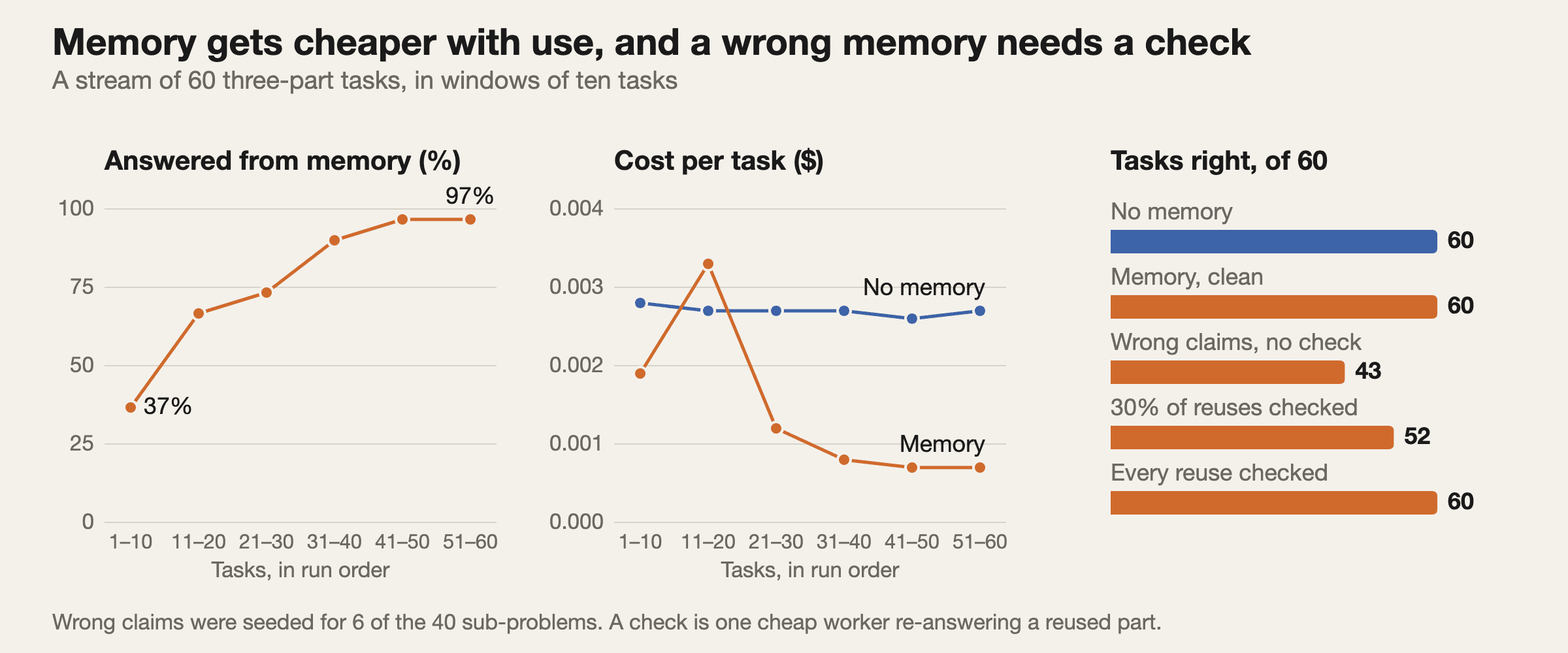
To watch memory learn I ran a stream of 60 three-part tasks over 40 computable sub-problems, repeats skewed so a few are asked often, one task at a time, so each could reuse only what earlier tasks had confirmed with two agreeing workers. From empty, the memory reused 37% of parts in the first ten tasks and 97% by tasks 41 to 50. Cost per task fell from $0.0019 to $0.0007 against a steady $0.0027 with no memory, though the second ten tasks cost more than the baseline ($0.0033) before the saving set in. Worker runs fell from 360 to 85 and a task took 8.8 s against 13.3. Accuracy was 60 of 60 either way: cheaper and faster, no gain in accuracy, since these parts are already within the cheap model's reach.
I then seeded the memory with wrong answers marked verified, for 6 of the 40 sub-problems (14% of parts). With no check it reused them whenever they matched and never corrected them: 43 of 60 tasks right, 17 lost to the baseline and none won, and the cheapest arm. Re-checking every reuse with one independent cheap worker caught each wrong claim on its first reuse, retired it and stored the right answer: 60 of 60 at $0.0020 a task, still 26% below no memory, with re-checks 41% of that arm's spend. Re-checking 30% of reuses caught four of the six and left nine parts wrong (52 of 60), because a wrong claim keeps being used until a sampled reuse tests it. The share re-checked sets the balance between saving and loss. The wrong answers were injected and the checker is right on these problems, so a checker sharing the mistake would catch less.
Accuracy on repeats (H19)
The last test asked for accuracy, not savings. 45 ARC puzzles have a second test input, which makes 92 natural repeats. Two Haiku workers with no memory got 12 of 45 first tasks right, with a rule verified on 12, 3 of them verified but wrong. I stored those rules and ran the 14 later tasks of those puzzles twice, once as before and once with the nearest stored rule, always from the task's own sibling, as a hint. Without the hint 9 of 14 were right and with it 8 (two gained, three lost, p = 1.0). Cost per task fell 81% and time 74%.
There was little to gain. The unhinted workers already solved 9 of 14, because a later task of a puzzle Haiku can solve is mostly easy for it, and the hint made workers verify a rule on every task while raising verified-but-wrong rules from 4 to 6. A rule that fits the worked examples can still miss the new test input, and handing it to a worker removes the independence that gave the baseline its second chance. It also means the 3 of 4 above overstated the hint, since those tasks were chosen because the baseline had failed them. In the stream's order only 6 of the 14 pairs have the first task before the later one, and the net change in tasks solved was zero. Hinted and unhinted answers agreed on 7 of 14 tasks and 6 of those were right, which suggests a stored rule as a second opinion beside an independent worker, not a replacement.
Agreement as a second opinion (H20)
I tested that free, from workers already run. Each of the 14 tasks had two unhinted and two hinted workers, giving 56 one-of-each pairings. The answers matched in 33 and the matching answer was right 29 times (88%), against 68% for one unhinted worker. Two unhinted workers matched on 11 tasks and were right on 8; two hinted matched on 12 and were right on 7. A policy that trusts agreement and sends the rest to Opus would escalate 41% of tasks at about $0.11 a task against $0.22 for Opus alone. This is weak evidence: the 56 pairs are four views of 14 tasks, Opus is assumed at its 82% rate on this kind of puzzle, and all 4 matching-but-wrong pairs came from one task where every worker made the same mistake, which agreement cannot detect. The ARC set has no more eligible puzzles, so a real test needs a larger workload with repeats.
What memory did
Memory reliably helps with the same problem again, for far less money: repeats got cheaper and faster, and on ARC repeats, the one place accuracy was below the ceiling, not more accurate. I did not find that it helps with a different problem that shares an idea, partly because the sets hardly contain such pairs. It also adds a risk the baseline lacks: a wrong answer stored as verified is repeated with confidence.
10. Local models (H6): no free first stage yet
If a first stage costs nothing in API terms, verification can be spent freely and Opus paid for only the tasks nothing local could verify. I installed Qwen3.6 in two sizes on a 64 GB laptop, a 35B mixture-of-experts model at about 53 tokens a second and a dense 27B at about 13. Both call tools through the same loop without trouble.
An overnight run put them in a ladder, three attempts on the fast model then two on the larger, the harness checking every rule against the worked examples. It finished six of the first twenty ARC tasks in eleven hours and solved none: no rule fitted all the worked examples on any of the six, across about 50 sandbox programs per task. On those six, Haiku alone also scored zero, Opus with tools three and the verified Haiku network five. These are the first tasks in the set and several were hard in the earlier pilot, so six is too few to say how often a local model verifies.
The second stage was not a fair test. Four of the six tasks logged a timeout on the 27B: one local call can think for over five minutes before returning anything and the client gave up after five, costing three retries and hours per task with no attempt to judge. That was a bug in my harness, now fixed, and says nothing about the model. A failing task took half an hour to nearly three hours either way, so the cost of a free first stage is time, and a lot of it.
I then ran DiffusionGemma (section 8) as the worker on the same six tasks, five attempts each. It needs an unmerged llama.cpp branch, which I built. It was quicker, 6 to 45 minutes a task, and also solved none. Ten of its 30 attempts stopped within 512 tokens and three calls ran past its 16,000-token context. I did not find out why the short ones stopped, so I cannot say whether it was the model or my handling of its tool calls.
My first run was wrong in an easy-to-miss way: the sampler reused one seed, so on five of six tasks the five attempts were one attempt made five times. The score was the same zero, and I noticed only because the attempts had identical token counts. With a fresh seed per request they differed on every task. Any result resting on repeated sampling from a local model needs that check.
A side finding: a 173 GB model on CPU alone decoded at 1.7 tokens a second, an order of magnitude slower than the 27B on the GPU. Fitting a model in memory is not enough; it must run on hardware that makes it fast.
11. Limitations
Each section gives its own caveats. These apply across the study.
- Samples are small. Most gaps sit inside the 95% intervals, and the headline positives (routing, memory as context) have p-values between 0.07 and 0.5.
- One controller carries most of the results. H7 is a control for that, and a weak one.
- Task choice matters more than strategy. Three generated families and GPQA were close to saturated for a cheap model with tools, so they cannot show composition helping. ARC is the only hard set, and it is the one where the network lost.
- One validation set I started with was contaminated, because Opus answered ten of ten questions whose files it could not open. I dropped it.
- Three rows in the ARC comparison had one attempt fail on a credit error from the model gateway. Dropping them leaves the result unchanged.
- Latency was measured and not optimised. Every escalating network is slower than the best model alone.
- The router and tool-router results are replays of runs already made, which assumes that a question's result does not depend on the router that sent it there.
12. What a dynamic-topology result should show
Claims about dynamic topologies are common, in papers and product pages, and easy to make in a way nobody can check. Building one showed me what I would want to see before believing the structure does the work.
Say which level it is
"The structure adapts per input" can mean gates inside one network, a choice between models, a workflow written per query, or rewiring within a run. Each has different costs and evidence, and a description that does not say which cannot be evaluated.
Name the baseline, and give it its tools
Compare against the best single model the same budget can buy, with the same tools. In this study that one change moved the headline result more than any composition idea.
Report cost and latency next to accuracy
A dense path for hard questions is difficulty-adaptive compute, and its whole case is a trade-off. On the hardest set here the adaptive network matched the best model's price exactly and took 4.8 times as long, which an accuracy table alone would hide.
Run the ablation that matters
Replace the chosen topology with a random one of the same size. If the result does not change, the value lies in the components or the budget and the structure adds nothing. DyTopo does this and passes.
Allow paired evaluation
Compare systems on the same questions, so small differences can be tested and not eyeballed.
Say what "verified" means in a memory
A system that stores its own results repeats them, so what it stores has to be checked at least as well as what it is used for. A result should say what the label means and what would catch a wrong entry. Here the label meant only that a program fitted the worked examples, and what caught wrong entries was an independent second answer.
None of this needs access to weights or training data. My own result points the same way: what moved the numbers was a tool the model could call and a check that either passed or failed, and the topology moved them little.
13. What would change my mind
A local first stage that verifies a meaningful share of ARC would turn the network's cost problem into a time problem. Neither local family I tried verified a rule on six tasks, so that needs a stronger local model or more tasks, and the second round plans 30. A task set needing both tools and hard reasoning, where a cheap agent is not already at 100%, would test composition properly. A controller fitted on these traces, or a calibrated confidence on the verifier, would show whether the controller is the limit.
For memory I need a test that can resolve what I could not: a set with real analogues between different problems, and accuracy on later problems from a library that grows as the system works, on a set where the cheap model is not already at 100%, plotted against the same system with no memory. The cost curve is measured (section 9) and the accuracy curve on ARC repeats was flat. A stored rule as a second opinion beside an independent worker looked useful on workers already run (H20), but the sample is 14 tasks and I have not run it live.
The second round covers most of this: 448 fresh or rerun reading and science questions, 120 ARC puzzles, a stream in which the cheap model fails some parts, and the agreement policy and the local gate both run live, with every test and decision rule fixed before the first paid row.
14. Conclusion
On this evidence a graph of models does not beat one good model that has its tools. It came close on routing, and it earned its place in two jobs: spending a cheap model's guesses safely when something can check them, and not repeating work whose answer is already known and verified. The most reliable result concerned the baseline, since giving the single model its tools moved the comparison more than any composition idea did. The ideas that survived were the least exotic: a check that either passes or fails, a gate that runs a stored program on the new problem's own examples, and a typed question that tells a paraphrase from a lookalike.
Memory is where the study is least certain. I set out to show that it makes the system more accurate, on repeats or on problems that resemble one it has solved, and I did not show it. What a memory holds is only as good as the check that stored it. If I ran the first round again I would judge every composition idea on the hardest set before any other, because a set a cheap model already solves cannot separate anything.
References
Related work, with the papers' own preprint or proceedings identifiers. Figures quoted from them are the authors' own and I did not reproduce them. Conformal Cascade is a recent preprint with no venue listed.
- Xu, C. and McAuley, J. A survey on dynamic neural networks for natural language processing. Findings of EACL, 2023. arXiv:2202.07101.
- Montello, F., Güldenring, R., Scardapane, S. and Nalpantidis, L. A survey on dynamic neural networks: from computer vision to multi-modal sensor fusion (early exits, routing with mixture of experts, token skimming), 2025. arXiv:2501.07451.
- Scardapane, S. et al. Conditional computation in neural networks: principles and research trends (early exit, mixture of experts, token selection). Intelligenza Artificiale, 2024. arXiv:2403.07965.
- Chen, L., Zaharia, M. and Zou, J. FrugalGPT: how to use large language models while reducing cost and improving performance, 2023. arXiv:2305.05176.
- Ong, I. et al. RouteLLM: learning to route LLMs with preference data, 2024. arXiv:2406.18665.
- Dou, Y., Lian, S. and Li, S. Conformal Cascade: distribution-free accuracy guarantees for multi-tier LLM inference, 2026. arXiv:2607.25018.
- Zhang, G., Yue, Y., Sun, X., Wan, G., Yu, M., Fang, J., Wang, K., Chen, T. and Cheng, D. G-Designer: architecting multi-agent communication topologies via graph neural networks. ICML 2025. arXiv:2410.11782.
- Zhang, G., Niu, L., Fang, J., Wang, K., Bai, L. and Wang, X. Multi-agent architecture search via agentic supernet (MaAS). ICML 2025. arXiv:2502.04180.
- Gao, H. et al. FlowReasoner: reinforcing query-level meta-agents, 2025. arXiv:2504.15257.
- Wang, S. et al. AgentConductor: topology evolution for multi-agent competition-level code generation, 2026. arXiv:2602.17100.
- Feng, T., Zhang, H., Lei, Z., Han, P. and You, J. GraphPlanner: graph memory-augmented agentic routing for multi-agent LLMs. ICLR 2026. arXiv:2604.23626.
- ARC-AGI-2, public evaluation set, for the hard-reasoning tasks.
- Lu, Y., Hu, Y., Zhao, X. and Cao, J. DyTopo: dynamic topology routing for multi-agent reasoning via semantic matching, 2026. arXiv:2602.06039. Figures above are from its Tables 2 and 8.
- Zhuge, M., Wang, W., Kirsch, L., Faccio, F., Khizbullin, D. and Schmidhuber, J. Language agents as optimizable graphs (GPTSwarm). ICML 2024. arXiv:2402.16823.
- Agent Patterns Catalog. Dynamic topology routing. https://www.agentpatternscatalog.org/patterns/dynamic-topology-routing/